For the complete documentation index, see llms.txt. This page is also available as Markdown.

Stakers

Stakers are LCC's capital providers: a staker posts margin, makes a promise, and sells 3Jane execution certainty, the right to call capital that stays in the staker's custody until it is needed. The payment for that option is a promise fee on the full promised notional, so the yield is levered: at launch terms, ≈ 20.2% APY on posted margin, plus a funding bonus on capital that is called.

Margin

Margin is the performance bond behind the position.

  • Each facility accepts one margin asset, a stable asset that is either a plain ERC-20 or an ERC-4626 vault share (Aave USDC, for example).

  • Margin keeps earning its own base yield while posted. Yield on a vault-share margin asset accrues inside the share and remains the staker's.

  • The facility's margin oracle values the margin in USDC terms; the pricing method and any haircut are per-facility terms in Facility Parameters.

Promise

The promise is the amount of USDC the staker can be called to deliver. It is opened against the margin at the facility's margin ratio:

promise = margin value / margin ratio

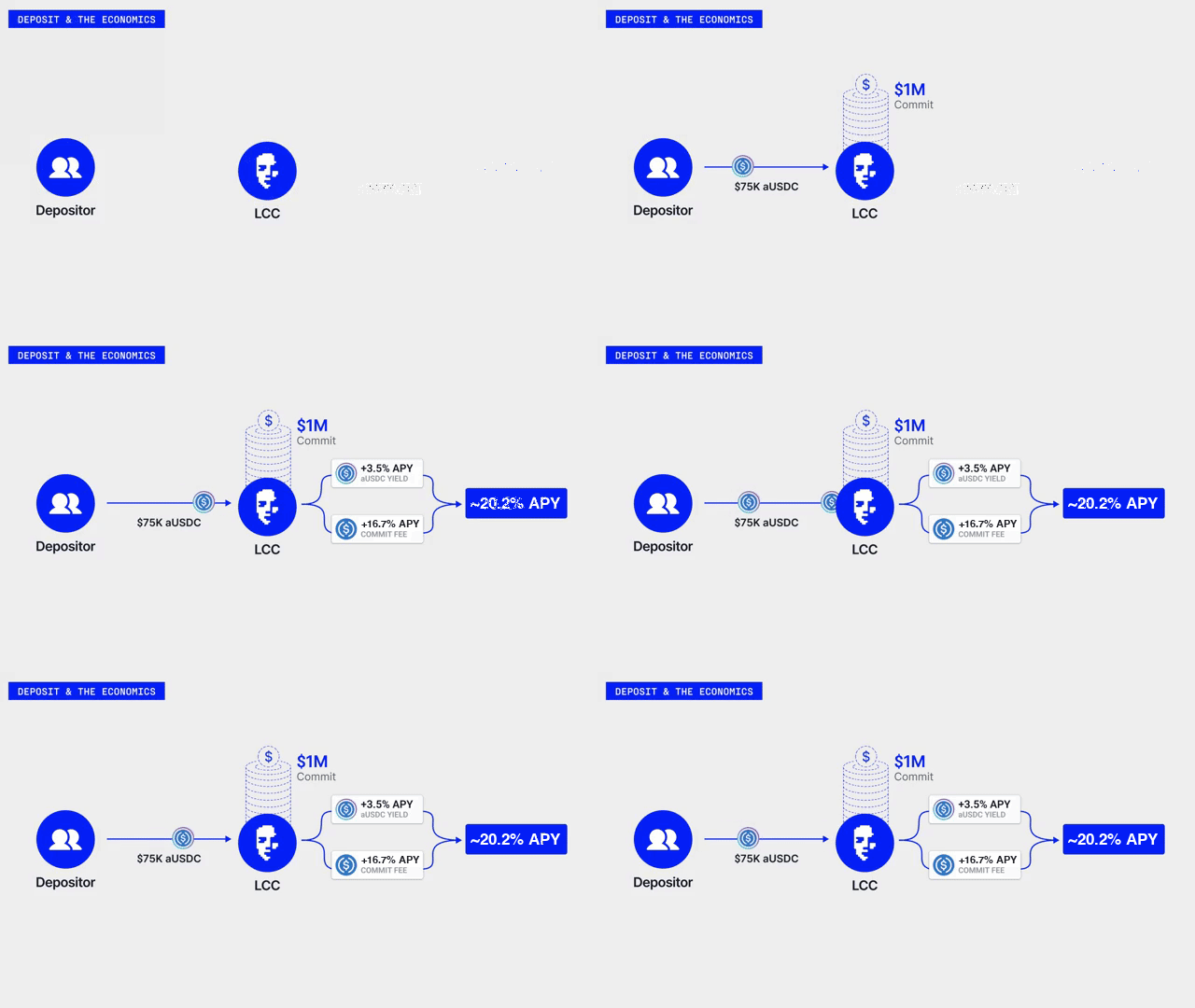
At the launch ratio of 7.5%, $75,000 of margin opens a $1,000,000 promise: every $1 of margin backs $13.33 of callable capital. Two things follow from the promise:

  • Calls are apportioned by it. When 3Jane opens a capital call, each staker owes a share pro rata to their active promise.

  • Fees are paid on it. The promise fee accrues on the promised notional, not on the margin, which levers the yield.

Animation: a staker posts $75k aaveUSDC margin backing a $1M promise
$75k of margin at a 7.5% margin ratio backs a $1M promise.
Staking

A stake is a margin deposit into a chosen facility, made through the app.

  • A stake activates immediately during the Normal phase, before any call has opened for the current epoch. Otherwise it activates at the start of the next epoch, so a stake can never be pulled into a call that was already open when it arrived.

  • A position is perpetual: the promise stays active and callable epoch after epoch until the staker unstakes. Funded calls pay it down, and rolling keeps it at full size (see Funding a capital call).

  • A position is account state, not a token. It cannot be sold or transferred.

  • The app quotes the promise before staking and bounds the stake with a slippage band, so a margin-price move between quote and execution cannot open a materially different promise than the one quoted.

  • New stakes are rejected while a shortfall auction is live in the facility and can be resubmitted once it settles.

Capitalization requirement

A promise is an obligation to deliver USDC on call, so each address's total promise is capped by the capital verifiable in it:

  • The first stake attempt verifies the address: a read-only sweep of the DeFi assets it holds, run in the app in a few seconds. No documents, no signup.

  • The verified amount sets an on-chain promise limit for the address: total promise is capped at 500% (5x) of the address's verified net worth. A stake that would promise beyond the limit is rejected.

  • The limit applies to the promise, not the margin. At the launch margin ratio of 7.5%, an address holding $100,000 of verified assets can promise up to $500,000, which takes $37,500 of margin.

  • The facility minimum of a 25,000 USDC promise therefore requires at least $5,000 of verified assets in the address.

  • The limit sits inside the per-account promise cap in Facility Parameters; the effective ceiling for an address is the lower of the two.

  • The limit is sized from the assets verified at verification time and can be re-sized from fresh verification data, in either direction.

  • A promise above 100% of the address's verified assets is allowed up to the limit, but the app flags it as undercapitalized before staking: a full call on that promise could not be funded from the verified assets alone.

The requirement exists because margin alone does not guarantee a call is funded. The bond is 7.5% of the promise while funding takes the full obligation in USDC, so the protocol also sizes every promise against capital the staker demonstrably controls. That keeps capital call funding reliable and, together with the eligibility rules above, keeps funding exposure diversified across genuinely capitalized counterparties.

Yield

An LCC position earns from two sources on posted margin, plus a funding bonus once capital is called.

1. Base yield on posted margin

The margin asset's own rate keeps accruing while posted; Aave USDC earns roughly 3.5%.

2. The promise fee

3Jane pays for the option on the staker's capital at a single rate:

Fee
Rate
Paid on

Promise fee

1.25% / year

Active promise

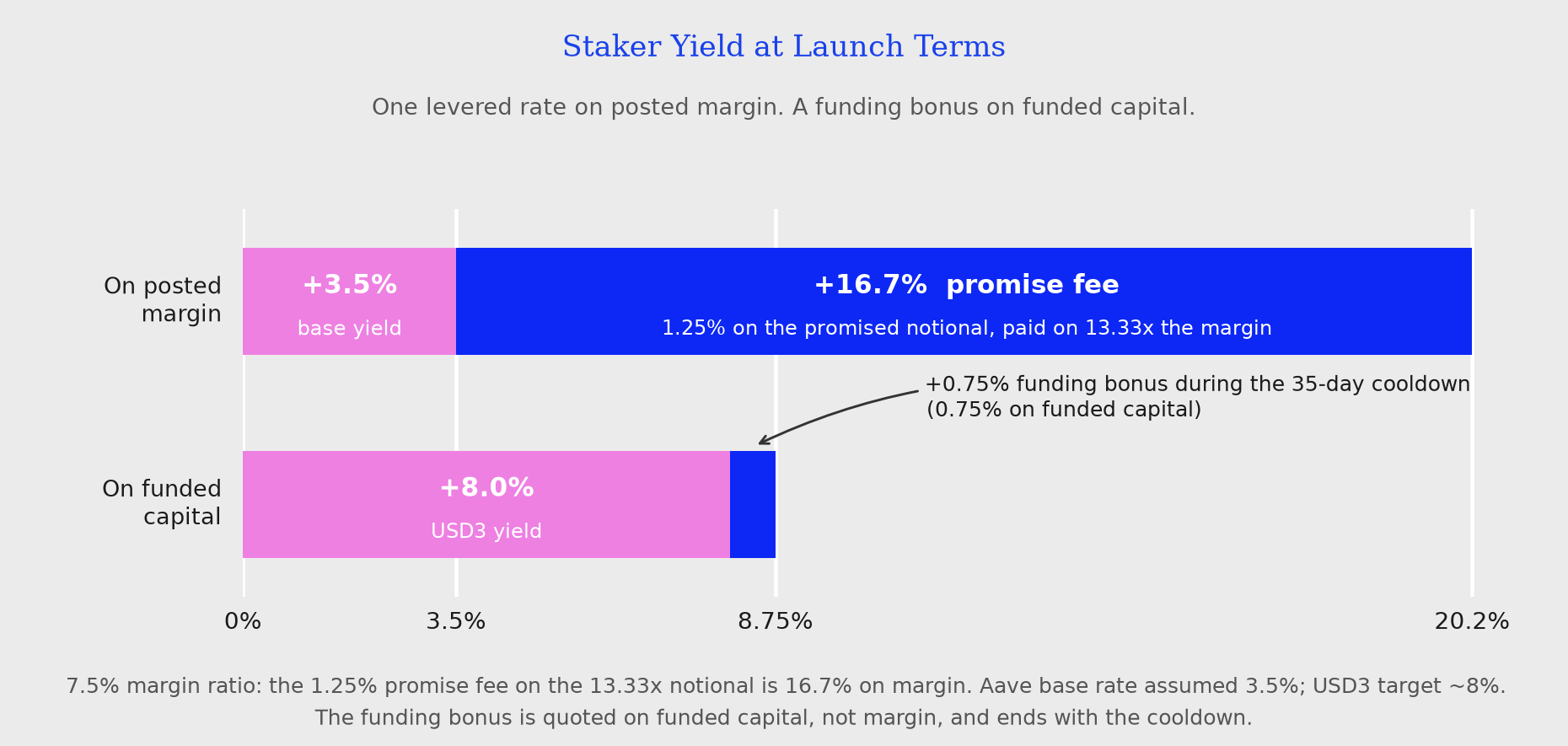
  • The fee is paid on the promised notional, 13.33x the posted margin, so on margin it translates to 16.7%. With the base yield on top, a position earns ≈ 20.2% APY on posted margin at launch terms.

  • The rate does not change with calls. Funding a call converts part of the promise into USD3 and releases the matching margin, so the remaining margin keeps earning the same levered rate on the remaining promise.

Holding the position is attractive while the levered fee plus the margin's base yield clears the staker's next-best stablecoin yield plus the cost of staying fundable:

At launch terms the left side is 20.2%.

3. The funding bonus

Funded capital is paid separately. USDC delivered into a call becomes USD3 in a 35-day cooldown, and while the cooldown runs it earns an additional 0.75% / year on top of USD3 yield: ≈ 8.75% at the ~8% USD3 target. The bonus is quoted on funded capital, not on margin, and it ends with the cooldown.

Staker yield at launch terms, on two capital bases: posted margin earns 3.5% base yield plus a 16.7% levered promise fee, about 20.2% APY; capital funded into a call earns roughly 8% USD3 yield plus a 0.75% funding bonus during the 35-day cooldown, about 8.75%
Two rates on two capital bases. Posted margin earns base yield plus the levered promise fee; funded capital earns USD3 yield plus the funding bonus during the cooldown.
The promise fee and the funding bonus are sent weekly in USDC directly to the staker's address. $JANE liquidity-mining incentives come on top.

Funding a capital call

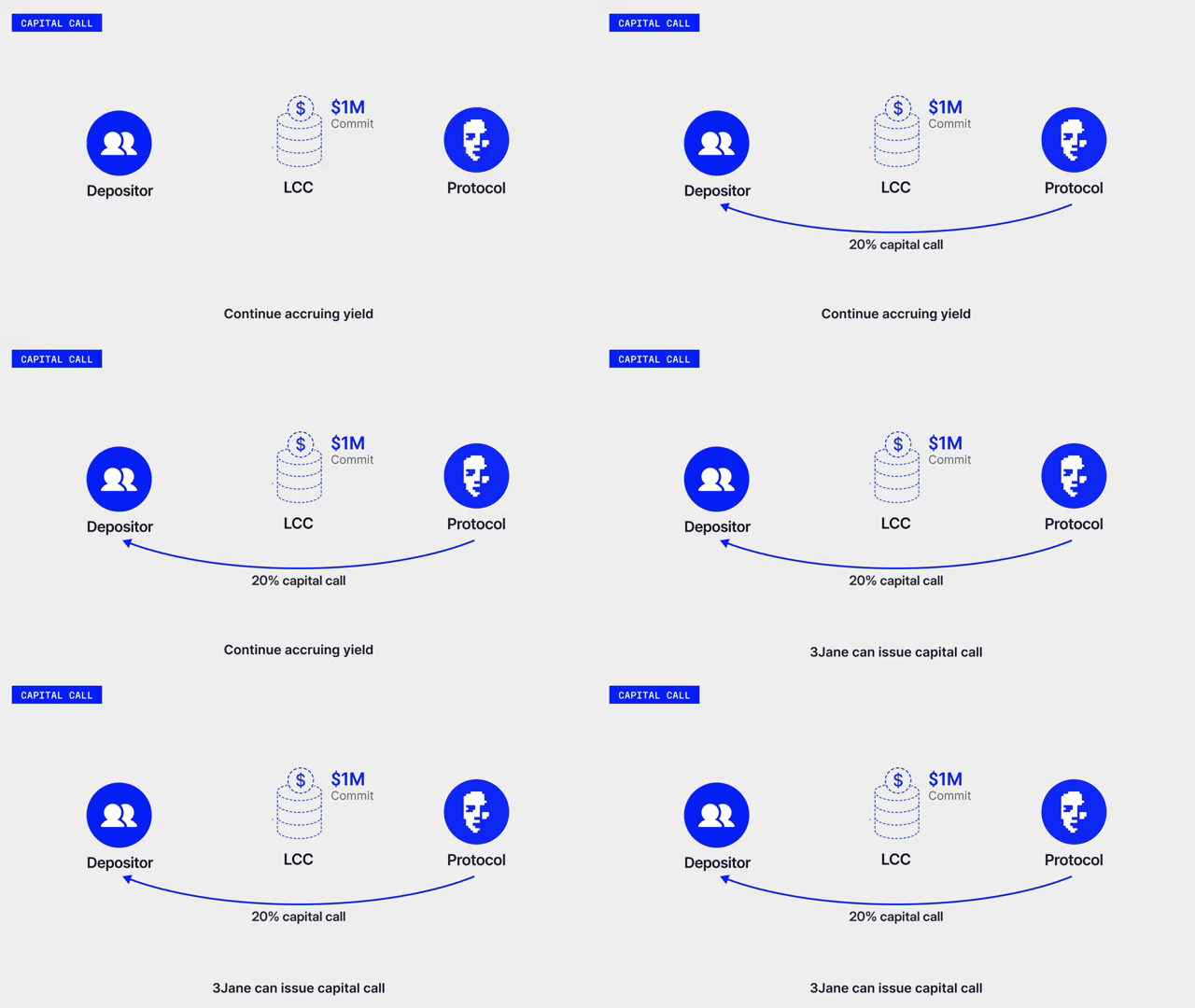
When 3Jane opens a call, the facility snapshots all active promises and each staker owes a pro-rata share:

Obligations are ceil-rounded per staker from the call-open snapshot (the frozen oracle price and promise denominator), so stakes and unstakes landing after the open cannot change anyone's share, and the sum of obligations can exceed the call amount by dust.

Calls are announced in the app and on Telegram. Funding is all-or-nothing: the full obligation in USDC, within the funding window (9 days at launch).

Animation: the staker harvests promise fees while 3Jane opens a partial capital call
The staker harvests promise fees until 3Jane opens a partial capital call against the unfunded promise.
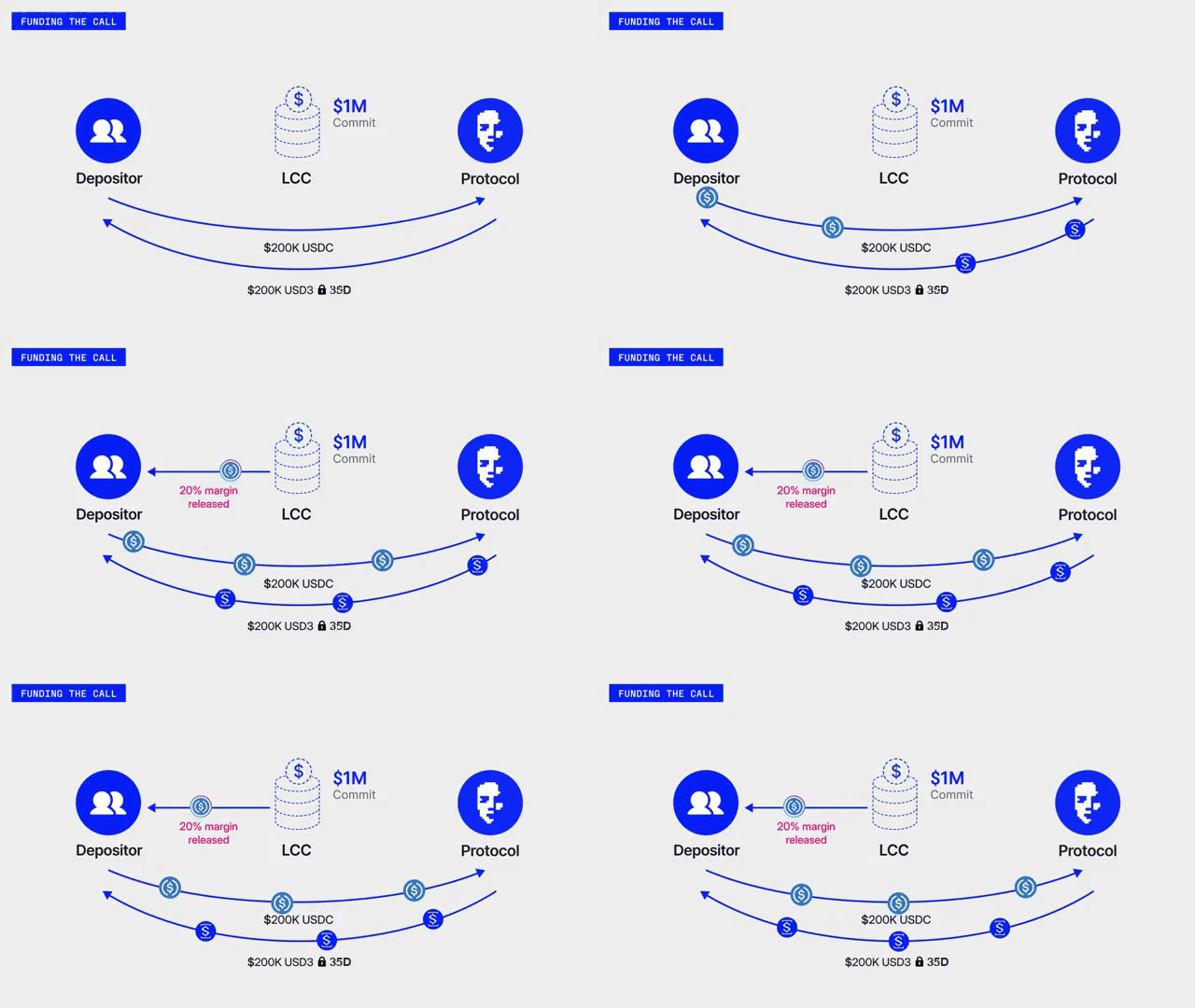
Funding has three effects:

  1. Delivers the exposure. The USDC routes into USD3 and the staker receives USD3 in a 35-day cooldown, earning USD3 yield plus the funding bonus from that moment and redeemable through USD3 liquidity once the cooldown ends. Settlement always mints at least one USD3 share, so the app sizes approvals with up to $0.001 of headroom.

  2. Releases margin. A proportional slice of the bond comes back: released margin = posted margin * obligation / promise.

  3. Pays down the promise. The callable notional drops by the funded amount, so the position winds down as capital deploys.

Animation: the staker funds the capital call in USDC and receives USD3 in cooldown, with a portion of margin released
Funding the call converts USDC into USD3 in cooldown. A proportional slice of margin is released.

Funding has two variations:

  • A facility may support rolling: funding while keeping full margin and full promise, which retains full fee earning power and re-arms callable exposure every epoch.

  • Any address can fund a staker's obligation on their behalf. Third-party funding always pays the promise down.

The funding cooldown

Funding a call delivers USD3 with a 35-day cooldown that starts when the call is funded.

  • During the cooldown the USD3 earns full yield plus the 0.75% funding bonus; nothing about it requires action.

  • When the cooldown ends, the full amount unlocks at once: the USD3 redeems to USDC through normal USD3 liquidity, or it can be held on as a yielding USD3 position. The funding bonus stops when the cooldown ends.

  • The cooldown is protocol-wide, 35 days across all facilities, and runs independently of the staked position: unstaking, further calls, and even a later slash have no effect on USD3 already in cooldown.

Missing a call

An obligation unfunded at the deadline slashes the staker's entire posted margin into the epoch's auction pool, but a slash is not a total loss:

  • The auction awards only the margin required to attract a fill, and recovery is proportional to the fill: the filled share of the pool, minus the award and the auction fee, returns as active margin with the matching promise restored.

  • The unfilled share of a shortfall is forfeited to the treasury, and an auction that ends with no fills forfeits the entire bond.

  • On a fully backstopped miss, the net loss is the auction's clearing discount on the missed amount, not the whole bond.

See Backstop Bidders for clearing dynamics and settlement, and the Worked Example for the numbers.

Unstaking

An unstake exits the full position:

  1. Request an unstake once the minimum staking period has passed (0 epochs at launch). Requests are full-position and irrevocable.

  2. Wait the unstake delay (2 epochs at launch) before the position can begin exiting.

  3. Exit through the per-epoch unstake capacity (20% of the facility per epoch at launch). If an epoch's capacity is full, the position exits in the next epoch with room.

  4. Claim margin once the position exits. Until then it remains callable and slashable, and funding during an unstake always pays the promise down.

Capacity is recomputed per request as a fraction of the larger of the facility cap and live active promises, and a request specifies the furthest maturity it will accept, reverting rather than landing later.

USD3 from funded calls is independent of the staked position: its cooldown runs 35 days from funding and it redeems through USD3 regardless of unstake status.

Last updated