> For the complete documentation index, see [llms.txt](https://docs.3jane.xyz/llms.txt). Markdown versions of documentation pages are available by appending `.md` to page URLs; this page is available as [Markdown](https://docs.3jane.xyz/levered-callable-capital-lcc/mechanism/backstop-bidders.md).

# Backstop Bidders

Backstop bidders are LCC's execution guarantee: when a staker misses a capital call, bidders fund the shortfall in USDC and are paid out of the slashed margin. For a bidder it is a defined, competitive path to acquire USD3 exposure at a discount, in exchange for standing ready to deliver certainty of execution.

The fill earns an immediate cash-on-cash return paid out of the staker's margin bond, on top of USD3 yield; on a full-promise fill the launch curve offers up to **6% instant, roughly +24 percentage points annualized over USD3** on a 90-day hold.

### Backstop sizing

The auction never has to clear a whole call, only the slice of it that defaults. Required bidder capacity therefore scales with expected defaults rather than with gross call size:

```
required backstop capacity ~= expected default rate * call size
```

Stakers are underwritten per address to keep that rate low, so a call measured in millions needs standing bidder appetite measured in a small fraction of that, and the ramp prices whatever does default. On a $10M call:

| Modelled default rate | Backstop capacity needed |
| --------------------- | ------------------------ |
| 1%                    | $100k                    |
| 5%                    | $500k                    |
| 10%                   | $1M                      |

Expected shortfall is an average, and a single large staker missing can exceed it. Per-account promise caps bound that tail:

```
largest single shortfall <= account cap * call fraction
```

so the worst single-account miss is set by the cap rather than by chance. This is why a thin network of institutional bidders can back a much larger promise pool.

### The auction

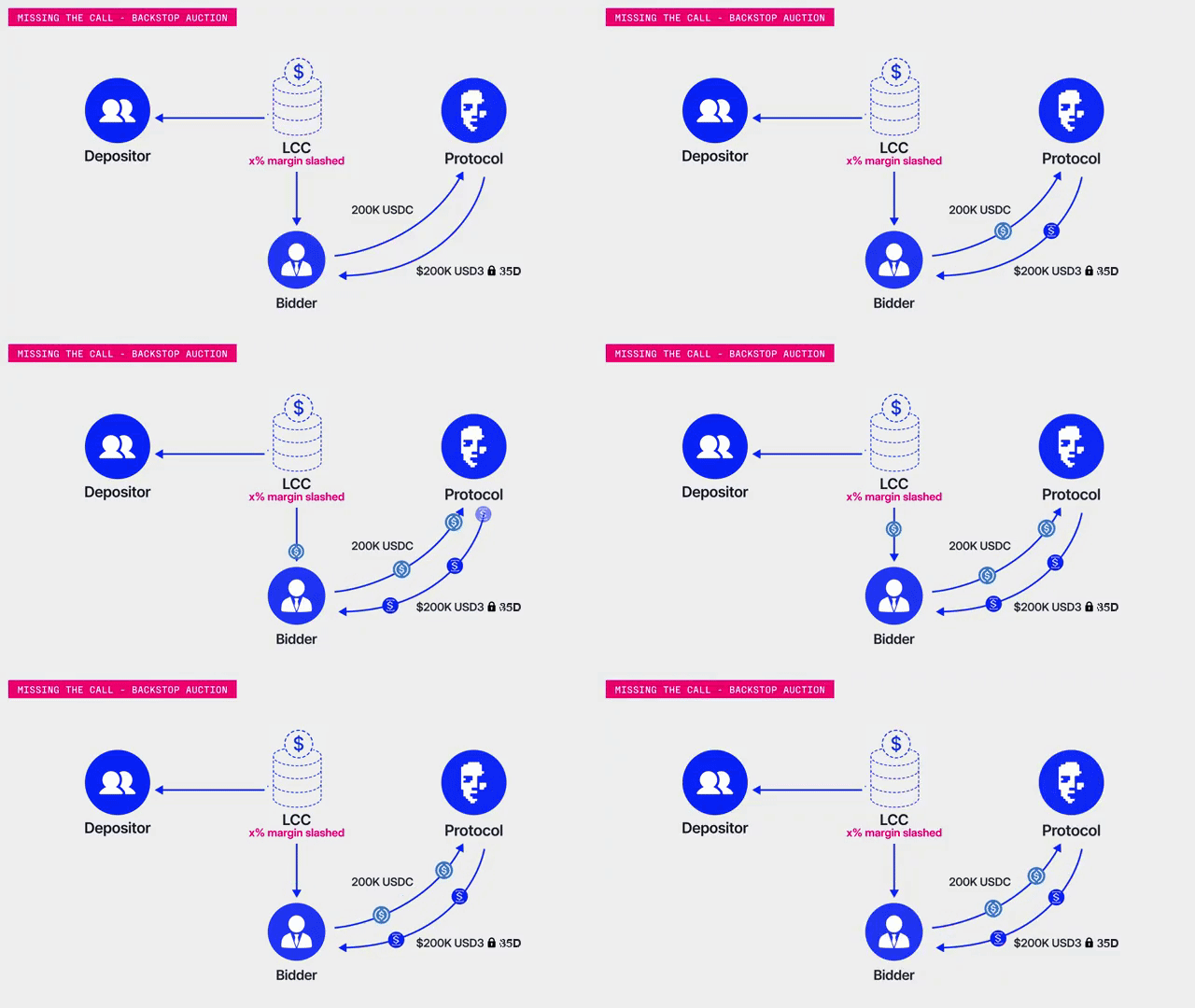
A missed call leaves a shortfall: called capital that was never delivered. The facility slashes the defaulting staker's entire margin into a pool and runs an auction over the epoch's auction window (4 days at launch). The pool is exactly the defaulters' margin:

```
pool = margin at call open - released to funders - funders' post-release margin
```

A roller releases nothing, so their full margin sits in the last term; the two funder terms sum to the funders' margin at call open. The auction determines how much of that pool it takes to get someone else to fund the call.

<figure><img src="https://1227041587-files.gitbook.io/~/files/v0/b/gitbook-x-prod.appspot.com/o/spaces%2Fv9UjcBMDpKGLDqrTs6IF%2Fuploads%2Fgit-blob-d8d3b3d675b3f410f214723b43eb4a04057d82e9%2Flcc-step-4-auction.gif?alt=media" alt="Animation: a missed call slashes the margin into a Dutch auction where backstop bidders fill the shortfall"><figcaption><p>A missed call slashes the margin into a step-decay auction. Backstop bidders fill the shortfall; surplus returns to the staker.</p></figcaption></figure>

The pool first reserves the auction fee: the maximum awardable margin is `A_max = pool * 10,000 / (10,000 + fee bps)`. The offer then starts near zero and ramps up each step of the window along a fixed decay curve, so the reward for filling grows the longer the shortfall sits unfilled:

```
offered(step) = A_max * (1 - (1 - d)^step)
```

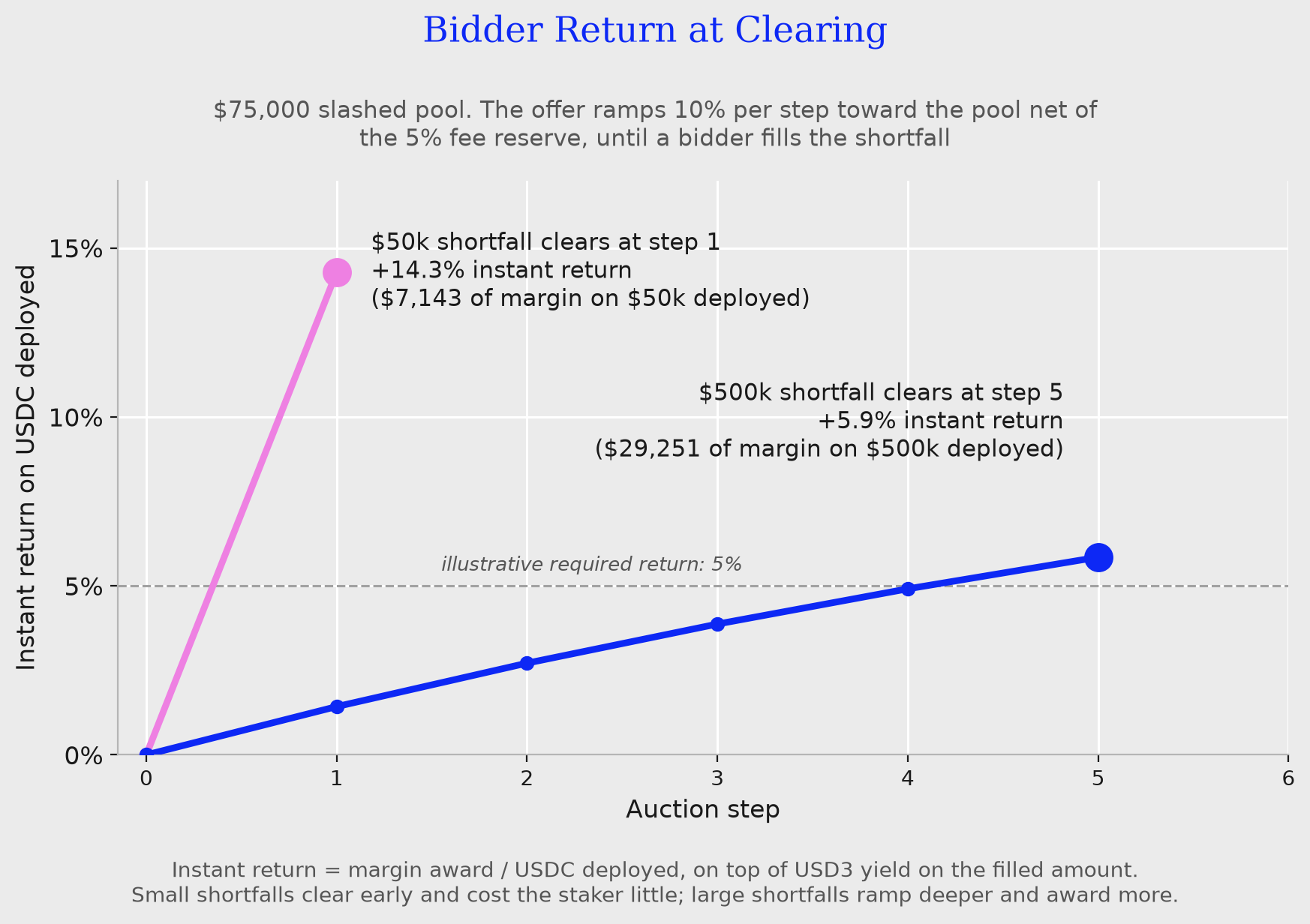
where `d` is the per-step decay rate: at launch, 30-minute steps at 0.84%, reaching about 80% of the pool by the end of the window, with no fee reserved. The clearing figure below uses a coarser illustrative curve (10% steps, 5% fee reserve) to make the steps visible.

A bidder can take the current offer at any moment by delivering USDC for some or all of the remaining shortfall, exactly as the staker would have. In return they receive the USD3 for the amount they funded, in cooldown, plus their slice of the margin on offer:

```
award = min( offered * fill / shortfall,    pro rata slice of the current offer
             fill * award cap,              per-facility cap per unit filled
             A_max - already awarded )      unawarded reserve
```

Auction rules:

* Bidding is permissionless: any address can fill.
* Open shortfalls are visible per facility once a funding deadline passes, and the offer advances in equal price steps (window length divided by step count).
* Fills execute first-come at the current offer, and partial fills leave the remainder on the curve for the next bidder.
* Bidders set a minimum acceptable award and a transaction deadline, so a fill cannot land on worse terms than quoted if the step advances or the oracle price moves mid-flight.
* Awards are paid in the facility's margin asset, valued at the live oracle price at fill time.
* One auction is live per facility at a time.

### Clearing

Bidders compete on time: filling early means a smaller award, but waiting risks being front-run. The auction clears once the offer makes the fill attractive relative to the capital deployed:

```
instant return = offered(step) / shortfall
```

Because the offer ramps as a fraction of the whole pool while the bidder's outlay is only the shortfall, the size of the miss decides how deep the auction runs:

* A small shortfall against a large pool clears within the first steps. Even a low offer is a high return on a small outlay, so little margin is awarded.
* A large shortfall must ramp deeper before the return clears a bidder's hurdle, and more margin is awarded.

<figure><img src="https://1227041587-files.gitbook.io/~/files/v0/b/gitbook-x-prod.appspot.com/o/spaces%2Fv9UjcBMDpKGLDqrTs6IF%2Fuploads%2Fgit-blob-732ade4dd6cc26e02b5335879ee1ff7740c83781%2Flcc-auction-clearing.png?alt=media" alt="Chart: bidder instant return on USDC deployed by auction step; a $50k shortfall against a $75,000 pool clears at step 1 with a 14.3% instant return, a $500k shortfall clears at step 5 with a 5.9% instant return"><figcaption><p>Same pool, same curve, different shortfall, on the illustrative coarse curve. The $50k miss clears at step 1; the $500k miss ramps to step 5 and awards more margin.</p></figcaption></figure>

### Returns

A fill pays in two parts:

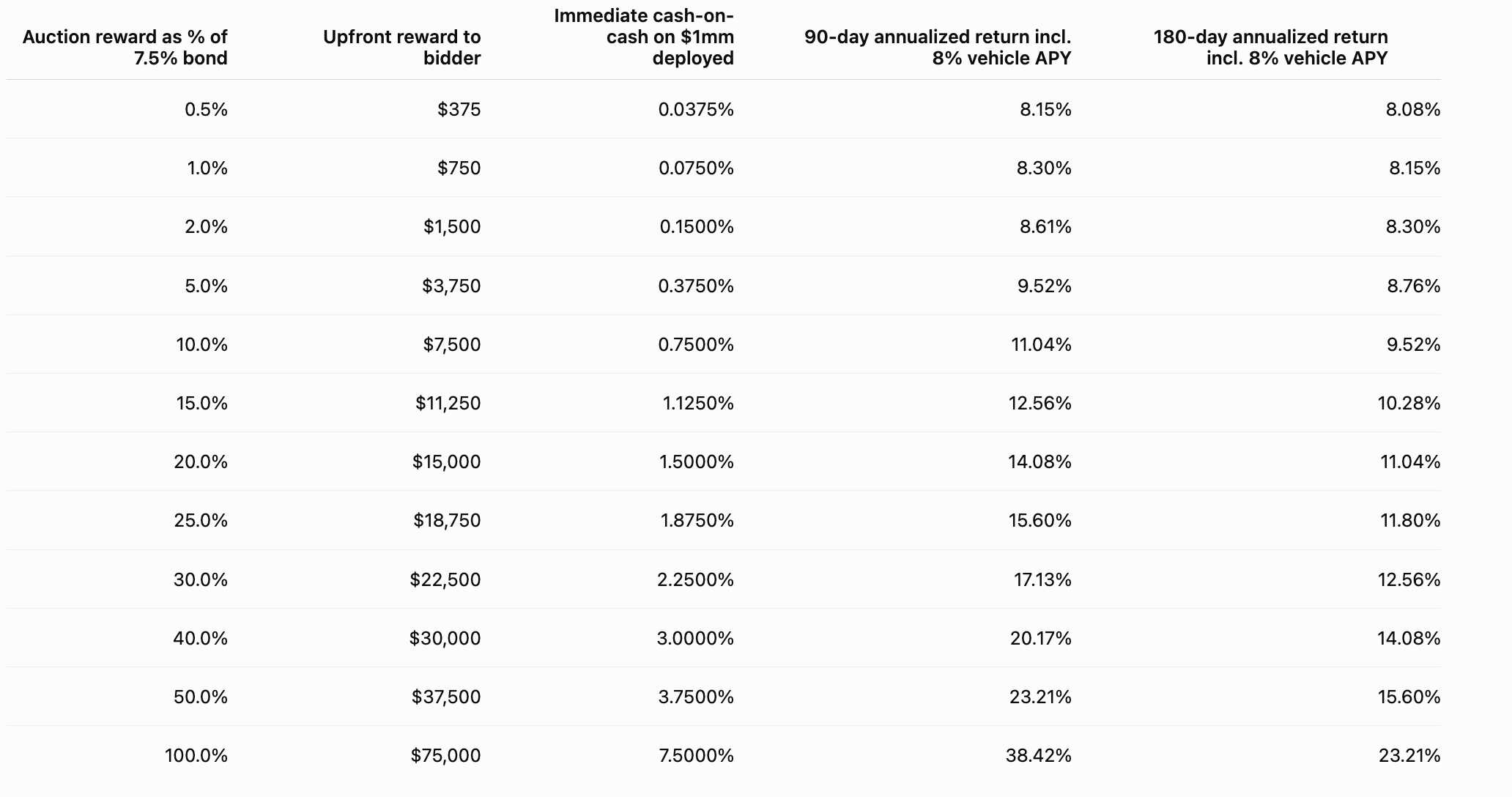
1. **The margin award**: an immediate cash-on-cash return on the USDC deployed. On a shortfall the size of the full promise, it runs from near zero up to about 80% of the 7.5% bond over the launch window, depending on where the auction clears; smaller shortfalls clear at higher instant returns, as above.
2. **USD3 yield** on the USD3 received, targeting \~8% unlevered APY.

```
bidder APY ~= USD3 yield + instant return * 365 / holding days
```

The annualized premium depends on the clearing level and the holding period. A clearing that awards half the bond pays about 3.75% instant on a full-promise fill, roughly +1,500 bps over USD3 annualized on a 90-day hold (about 23% all-in) or +750 bps on 180 days, and a full-curve clearing at launch, about 80% of the bond, pays about 6% instant, roughly +2,400 bps on the 90-day hold.

<figure><img src="https://1227041587-files.gitbook.io/~/files/v0/b/gitbook-x-prod.appspot.com/o/spaces%2Fv9UjcBMDpKGLDqrTs6IF%2Fuploads%2Fgit-blob-7c6ec535a688d8520db58d82c9bea36cb6d1758d%2Flcc-bidder-returns.png?alt=media" alt="Auction bidder return sensitivity: upfront reward, immediate cash-on-cash on $1mm deployed, and 90-day and 180-day annualized returns including 8% vehicle APY, across auction rewards from 0.5% to 100% of the 7.5% bond"><figcaption><p>Bidder returns by auction reward as a percentage of the 7.5% margin bond, on $1mm deployed, including 8% USD3 vehicle APY.</p></figcaption></figure>

### Settlement

When the auction settles, on a full fill or at window end, return eligibility is proportional to the fill:

```
eligible     = floor(pool * filled / shortfall)
fee          = min(fee basis * fee bps / 10,000, unawarded surplus)
return pool  = eligible - awarded - fee
to treasury  = pool - return pool
```

A fully filled shortfall makes the whole pool eligible, so the staker recovers everything except the award and the fee. A partially filled shortfall forfeits the unfilled share of the pool to the treasury, and an auction that ends with no fills forfeits the entire pool. The return pool goes back to the defaulting staker as active margin with the matching promise restored. The conversion into restored promise uses the oracle price frozen at call open, never the live price, and the restoration is capped at the promise the slash removed, so a default-and-return cycle cannot increase the total promise.

### Joining the bidder network

Bidding requires no onboarding; to coordinate with 3Jane's network of institutional backstop bidders, reach out to [@uhr3al](https://x.com/uhr3al) on Twitter or Telegram.