> For the complete documentation index, see [llms.txt](https://docs.3jane.xyz/llms.txt). Markdown versions of documentation pages are available by appending `.md` to page URLs; this page is available as [Markdown](https://docs.3jane.xyz/levered-callable-capital-lcc/introduction.md).

# Introduction

Levered Callable Capital (LCC) turns unfunded committed capital into a globally syndicated, permissionless primitive. Stakers post margin to back a larger callable standby, harvest standby fees on the full standby notional, and fund capital calls in USDC when 3Jane has eligible deployment. Backstop bidders fill any missed calls in exchange for slashed margin.

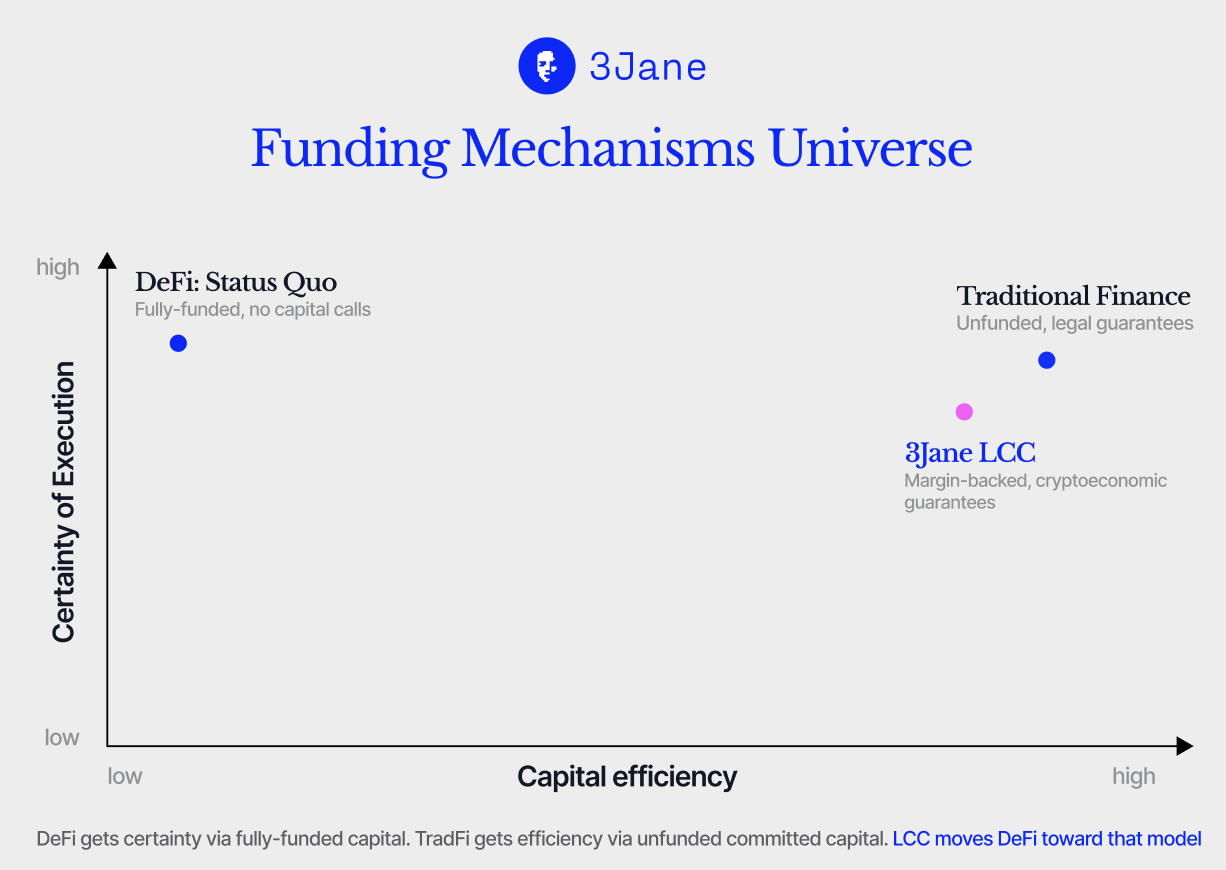
Enforcement is a margin-backed cryptoeconomic guarantee rather than a legal agreement, combining the capital efficiency and execution certainty of traditional finance with the scale, standardized clearing, and distribution advantages of DeFi. Committed capital becomes contingent capital: an internet-native asset class of balance sheet capacity that stays productive until needed and turns into real funding the moment credit demand appears.

<figure><img src="/files/HHyGVdsuxhVAx267oqZo" alt="Funding mechanisms universe: DeFi status quo is fully funded with no capital calls, traditional finance is unfunded with legal guarantees, 3Jane LCC is margin-backed with cryptoeconomic guarantees"><figcaption><p>DeFi gets certainty via fully funded capital. TradFi gets efficiency via unfunded committed capital. LCC moves DeFi toward that model.</p></figcaption></figure>

Swapping legal enforcement for margin does more than port the capital call onchain; it changes what committed capital is.

### Capital efficiency with execution certainty

Uncalled capital never leaves the staker's wallet. It stays deployed wherever it already is, earning whatever it already earns, while the standby collects fees on top. 3Jane pulls USDC only when a deal is ready to fund, so neither side warehouses idle capital.

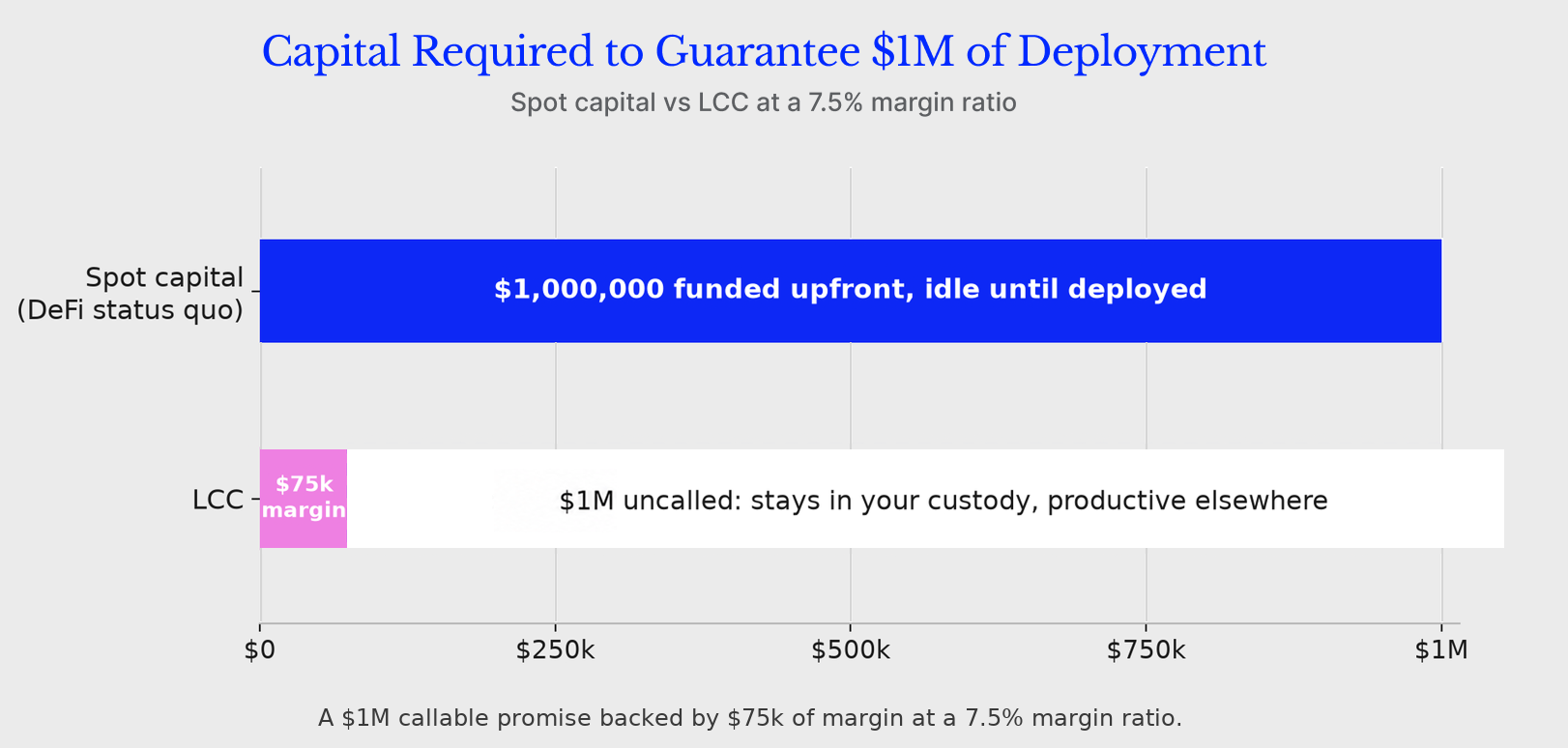
To guarantee $1M of deployment, the spot-capital model needs the full $1M deposited and idle. LCC takes a $75,000 performance bond and a callable claim on the rest. The trade is cheap for the issuer as well:

```
cost of prefunding = target yield - idle yield     (cash drag)
cost of standby    = standby fee
```

At an 8% USD3 target and a 3.5% idle rate, prefunding certainty costs about 4.5% a year against 1.25% for the standby, more than three times the price.

<figure><img src="/files/gZkRTwz0tNY2g6EOVmL0" alt="Comparison: guaranteeing $1M of deployment requires $1,000,000 funded upfront under the spot-capital model, versus $75k of posted margin under LCC with the $1M standby uncalled and productive in the staker&#x27;s custody"><figcaption><p>The same $1M of funding certainty. Spot capital funds it upfront and lets it idle. LCC posts $75k of margin and leaves the $1M standby productive until called.</p></figcaption></figure>

### Contingent capital as a bearer asset

A TradFi commitment is a bilateral contract bound to one LP: it cannot trade or move, and the balance sheet that signed it is the only one that can ever honor it. An LCC standby is a bearer asset, defined by margin and terms rather than by who signed it, which lets contingent capital trade and transfer to whichever balance sheet prices it best and makes a secondary market for contingent capital a property of the asset itself.

### The auction as clearinghouse

A clearinghouse can only operate on standardized obligations, and every standby in a facility carries identical terms: every missed call is the same object, a shortfall backed by slashed margin, and the backstop auction can clear all of them. When an LP defaults in traditional finance, enforcement takes years of legal process. When a staker defaults in LCC, the auction reprices the missed call over a 4-day window and a bidder steps in to fund it.

### Permissionless capital formation

Because enforcement is margin rather than law, writing a standby does not require negotiating fund documents or waiting on an allocation. Balance sheet capacity is syndicated globally through the protocol, and the pool of contingent capital scales with distribution rather than with a fundraising process.

***

See [Mechanism](/levered-callable-capital-lcc/mechanism.md) for how the guarantee works, step by step.